Ford Everest Problems: Used Buyer's Guide for UA, UA II and Next-Gen Models
Most Ford Everest problems that owners and Australian 4WD press report come down to four things: the wet timing belt in the 2.0 bi-turbo diesel, heat-related wear in the 6-speed and 10-speed automatics, EGR/AdBlue faults, and hard towing or off-road use. Several safety recalls also apply, so confirm recall completion and run a PPSR check before you pay.
Last updated: 26 October 2026
| Key facts | Ford Everest (Australia) |
|---|---|
| Generations | UA (late 2015–2018), UA II / MY19 update (2018–2022), next-gen (2022 on) |
| UA / UA II engines | 3.2L five-cylinder turbo-diesel, 143–147kW / 470Nm, 6-speed auto. 2.0L Bi-Turbo diesel, 157kW / 500Nm, 10-speed auto (from MY19) |
| Next-gen engines | 2.0L Bi-Turbo, 154kW / 500Nm. 3.0L V6 turbo-diesel, 184kW / 600Nm. Both use the 10-speed auto (10R80) |
| 2026 change | Bi-Turbo dropped. An updated single-turbo 2.0 with a timing chain replaces it (reported by GoAuto); confirm the actual build specification |
| Braked towing | UA 3.2: 3,000kg. UA II 2.0 Bi-Turbo: 3,100kg. Next-gen: 3,500kg (GCM 6,250kg); confirm vehicle-specific limits |
| Recalls to check | Side airbags, steering shaft, seat frame, 10-speed fluid pump, tow-bar hitch, V6 cam sprocket, park/battery software, windows, reversing camera and more (see below) |
| Our pick | Comprehensive for most buyers. Elite for tow rigs and high-km 2.0 Bi-Turbos. Prices, SAVE10 and Afterpay shown below. |
Which Ford Everest generations and engines are on the used market?
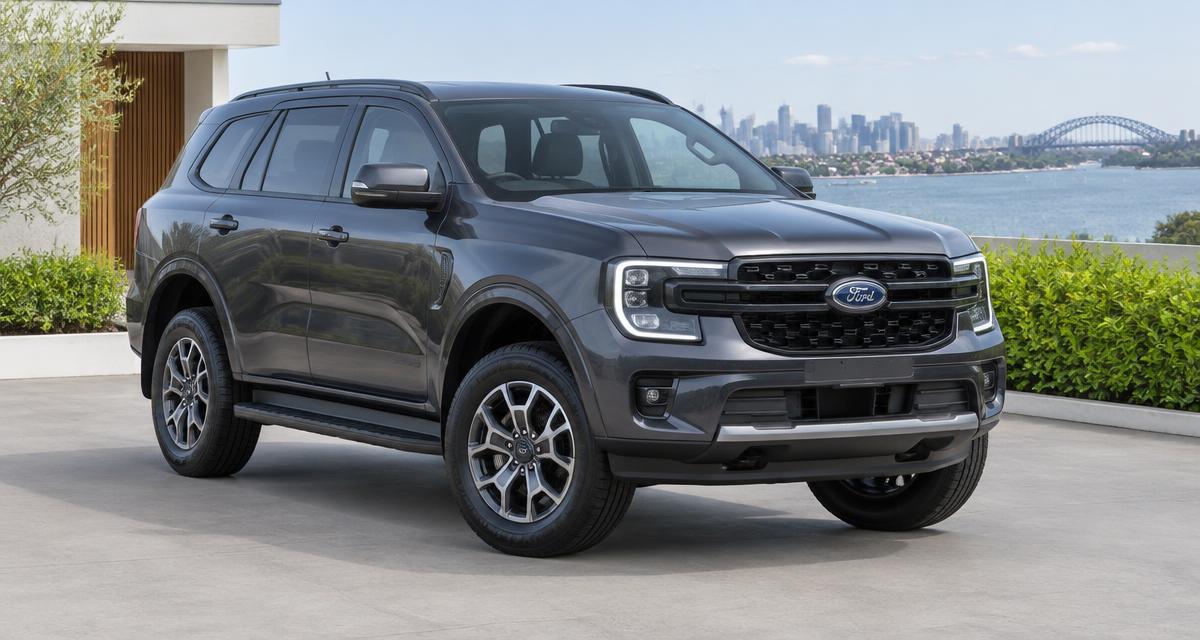
The Everest arrived in Australia in late 2015 as a Ranger-based seven-seat wagon. Here's how the used stock breaks down:
- UA (2015–2018): 3.2-litre five-cylinder Duratorq diesel (147kW/470Nm) with a 6-speed automatic. Towing was rated at 3,000kg braked.
- UA II (MY19 update, 2018–2022): Ford added the 2.0-litre Bi-Turbo four-cylinder (157kW/500Nm) with a 10-speed auto. The 3.2 stayed on in some grades, quoted by Drive at 143kW/470Nm. Drive reported 3.1 tonnes braked towing for the Bi-Turbo and 3.0 tonnes for the 3.2. Some grades were sold as rear-drive and some as 4x4, so check which one you're looking at.
- Next-gen (2022 on): Ambiente and Trend got a 2.0 Bi-Turbo (154kW/500Nm). Sport and Platinum got a 3.0 V6 turbo-diesel (184kW/600Nm). Every version uses the 10-speed 10R80, and 4x4 models have full-time 4WD with low range. Ford quotes 3,500kg braked towing across the range.
- 2026 update: GoAuto reported that Ford is dropping the Bi-Turbo from Everest and Ranger. It's being replaced by an updated single-turbo 2.0 that runs a timing chain instead of the wet belt.
A quick note on the "single-turbo 2.0": the owner’s research turned up no Australian-market Everest with a single-turbo 2.0 before the 2026 change. If a listing says "2.0 single-turbo" on an older Everest, check the build plate and VIN with the seller.
What are the most common Ford Everest problems?
These are issues reported by owners and the Australian 4WD press. They're not failure rates. Plenty of Everests never have any of them. They're the things worth investigating before you hand over money.
2.0 Bi-Turbo wet timing belt
Unsealed 4X4 rates belt wear in the 2.0 diesel as a high-severity issue. In this engine the timing belt runs in oil. As it breaks down, fibres can block the oil pick-up and starve the engine, and the belt itself can fail. Early warning signs are easy to miss: dirty oil at services, then clanking or grinding noises. CarsGuide owner Q&As include worried 2020 Trend owners asking about the same belt. GoAuto called it "troublesome" when it reported Ford's move to a timing chain. What it means for you: service history matters more on a Bi-Turbo than on almost any other used 4WD. Missed or late oil changes are a red flag, and so is a vehicle that has done a lot of heavy towing.
EGR and AdBlue faults
Unsealed 4X4 reports EGR coolers that can leak coolant into the engine, and AdBlue systems that can crystallise and fail heaters, pumps and sensors. Symptoms include smoke, rough running, coolant loss with no visible leak, and limp mode. Marque News reports that some owners got false AdBlue tank readings on 2015–2021 models. If the system can't detect AdBlue the engine won't start, and a dealer can recalibrate it. Also note that removing emissions equipment is illegal on a road-registered vehicle. A "deleted" Everest is a problem, not a bonus.
6-speed automatic (6R80) on the 3.2
Owners report erratic shifting, flaring between gears, and clunks on take-off and when pulling up. Unsealed 4X4 links this to very long fluid service intervals and a thermostat that holds back fluid cooling until it warms up. Marque News also notes the 5th-to-6th shift can be harsh. Common owner fixes are fluid changes every 40,000–60,000km and an auxiliary cooler. These are reported approaches, not a universal service interval or a guaranteed fix; use the matching Ford schedule and qualified diagnosis.
10-speed automatic (10R80)
Unsealed 4X4 says the 10-speed has weak points in the torque converter, valve body and a clutch drum, and that heat is the main killer. Its suggested fixes match those for the 6-speed: more frequent fluid changes and extra cooling. A CarsGuide owner question describes a 2021 Everest auto that seems to skip gears. Another, on a 2024 Trend, reports vibration through the steering and floor during gear changes. Separately, the 10-speed's fluid pump was the subject of a recall (see below). Reported fixes need vehicle-specific workshop advice.
Intercooler pipe, trim, rust and tailgates
Unsealed 4X4 also lists:
- Intercooler hot-side pipes on the 2.0 diesel that go brittle and pop off under boost, causing a bang, power loss and possibly limp mode
- Interior and exterior plastics that discolour or turn brittle in Australian sun
- Paint bubbling along door, bonnet and tailgate seams on some vehicles
- Power tailgate faults usually traced to the module, actuators or connectors
A CarsGuide owner also asked about sun-damaged roof rails on a 2015 Everest.
What Ford Everest recalls should I check?
Australian vehicle recalls used to be listed on the ACCC's productsafety.gov.au. They now sit on the federal vehicle recall database (vehiclerecalls.gov.au), and older notices still carry their PRA numbers. These are the Everest recall notices supplied with the owner's research, not an exhaustive VIN-specific list. Have the seller or a Ford dealer confirm by VIN that each relevant one has been completed:
| Recall | Models / years | Issue |
|---|---|---|
| REC-000302 (PRA 2017/16321) | Ranger & Everest 2016–2017, 1,206 units | Side airbag initiators may contain an incorrect chemical mixture, so the airbag may not deploy |
| REC-000314 (PRA 2018/16826) | Everest & Ranger, 288 units | Intermediate steering shaft weld may be out of spec, with a risk of losing steering |
| REC-000312 (PRA 2018/16987) | Everest MY2018, 60 units | Seat cushion frame welds may fail |
| REC-003914 (PRA 2020/18271) | Ranger & Everest, 15,135 units | Transmission fluid pump gears may fail, causing loss of drive. 4X4 Australia reported this covers 10-speed Bi-Turbo vehicles built 30 May 2018 to 16 October 2019 |
| REC-004968 | Ranger & Everest 2016–2021, 287 units | Rhino-Rack Sunseeker awning mounting bolts may break |
| REC-005759 | Ranger & Everest 2021–2023, 4,841 units | Software may shift the transmission to Park at low speed when the battery is low, with no brake lights |
| REC-006100 | Everest & Transit Custom 2022–2024, 38,423 units | Power window auto-reverse may not work |
| REC-006358 | Multiple Ford models incl. Everest 2022–2024 | Reversing camera image may not display |
| REC-006341 | Ranger & Everest 3.0 V6 2022–2025, 13,490 units | Left-hand camshaft sprocket may fracture, causing a stall and loss of power |
| REC-006409 | Mustang, Ranger, Everest 2025, 13 units | Transmission valve body may be out of spec, so the vehicle may not reverse or may move unexpectedly |
| REC-006429 | Everest MY2021, 701 units | Tow-bar hitch may not be welded to spec and could detach |
If you're buying a 3.0 V6 next-gen, make the cam sprocket recall (REC-006341) a priority. On any Everest that will tow, check the 2021 tow-bar hitch recall (REC-006429).
How do towing and 4WD use wear an Everest?
Everests get bought to tow, and a lot of them do it hard. Drive's 2019 towing test near Wollongong found that engine temperature rose and fuel use reached about 18L/100km with a heavy van on a climb. Unsealed 4X4 notes that heavy towing speeds up wear on both the wet belt and the transmission, and recommends shorter service intervals. Marque News warns that many Everests have seen serious off-road use. Its advice is to look for scratches on the body sides and bumper corners, check underneath around the engine and transmission, and lift muddy carpets (with the seller's OK).
Signs of a hard-worked tow rig:
- Worn tow-ball and hitch receiver
- Aftermarket brake controller wiring
- Heavy-duty or lifted suspension
- Rear tyres worn harder than the fronts
- Transmission fluid that's dark or smells burnt, where safely accessible
None of these rules a car out. They just mean the history and our inspection need to back it up.
What our inspectors check on a Ford Everest
On an Everest booked as Comprehensive or Elite we work through our 150+ Point Checklist, with attention to the areas below. It's not a claim that any particular car has these faults. These are inspection priorities within the booked package, not a promise that every tier includes every check. Essential is narrower; Comprehensive and Elite include the 150+ Point Checklist. Cold-start assessment and paint-depth readings are Elite-only. Checks depend on safe access, seller permission, compatible diagnostic modules and test conditions; unavailable checks are recorded as limitations.
- 1.Service history against the engine. On a 2.0 Bi-Turbo we look at oil change intervals and any belt work. On a V6, request evidence of REC-006341 completion and have Ford confirm it by VIN. Advanced recall history review is an Elite inclusion, not certification of completed campaigns.
- 2.Engine oil condition and colour where accessible, plus unusual belt or chain noise at idle. Elite includes a cold-start assessment when the seller leaves the engine cold; no package promises internal timing-belt inspection without access.
- 3.Coolant level and condition, checked safely without opening a hot system. Unexplained coolant loss can point to EGR cooler trouble.
- 4.Scan for stored and pending fault codes in supported engine, transmission, AdBlue/SCR, DPF and body modules. Module access depends on the vehicle and equipment; a scan is not a diagnosis of every possible fault.
- 5.AdBlue level, gauge reading and warning history, where fitted.
- 6.Intercooler pipework and clamps for accessible cracks, oil mist or signs of being refitted.
- 7.Transmission fluid condition where accessible, plus shift quality during the permitted road test. That means the fitted 6-speed on the 3.2 or 10-speed on the 2.0 and V6; not a promise to exercise every ratio or reproduce every temperature and load.
- 8.4WD system. Check fitted high/low-range engagement, rear diff lock and terrain-mode selection only as the matching manual permits and conditions allow.
- 9.Underbody. Accessible bash damage to the sump, transmission and transfer case, chassis rails, and rear bar and tow-bar welds (especially MY2021, see REC-006429). No structural or towing-compliance certification.
- 10.Suspension, steering and tyres, looking for towing or lift-kit wear.
- 11.Body seams on doors, bonnet and tailgate for bubbling paint. Comprehensive includes panel gaps, overspray and body-repair indicators; paint-depth readings are Elite-only. Essential does not include advertised accident/repaint detection.
- 12.Power tailgate, windows, reversing camera, SYNC infotainment and cabin electrics within scope. We observe operation and alerts, not certify window pinch protection or other active-safety performance.
- 13.Third-row seats and fold mechanisms, plus interior plastics for UV damage.
- 14.PPSR check (included in Comprehensive, Elite and Ute, Van & Light Truck) for registered security interests and recorded written-off or stolen status; it does not show every accident repair or certify mechanical condition.
Road-test scope follows the booked package: Essential 3–5 km, Comprehensive 6–10 km and Elite 10–12 km, where safe and permitted. A limited unloaded drive cannot guarantee a fully hot and cold assessment or reproduce towing loads.
Test-drive checklist for a used Everest
Confirm seller permission, licence and insurance arrangements. These are buyer-viewing suggestions, not extra promised inspection scope. Use a safe legal route, stay in control and follow the matching owner's manual.
- Start it cold if arranged. Ask the seller not to warm it up. Listen for rattles, knocks or a rough idle, and watch the exhaust for smoke. Record if it is already warm rather than assuming concealment.
- Watch the dash for engine, wrench, AdBlue or transmission warnings, both after start-up and throughout the drive.
- Gentle take-off from a stop, several times where safe. Feel for clunks, flare or hesitation.
- Steady legal-speed cruise where safe and permitted. Feel for shudder or vibration through the floor or wheel during gear changes.
- Moderate acceleration on a suitable hill, without forcing a fault. Listen for unusual boost noises and watch for loss of power.
- Manual mode. Observe available shifts safely, following the manual rather than forcing every ratio.
- Low-speed manoeuvring. Check that the reversing camera displays.
- Engage 4WD low range and the diff lock only where fitted, permitted and safe, on a surface allowed by the manual. Do not use locked modes on sealed roads.
- After the drive, look for fresh drips without crawling under an unsupported vehicle. Check coolant only once it's cooled; never open a hot coolant system.
What paperwork and PPSR checks do I need?
- PPSR search at ppsr.gov.au by VIN. It shows registered security interests and recorded written-off or stolen status, not every debt or hidden repair. Our Comprehensive, Elite and Ute, Van & Light Truck packages include it.
- Service book or Ford dealer history, matched against the odometer. On a Bi-Turbo, ask specifically about the oil service record and any belt replacement.
- Recall completion. A Ford dealer can confirm open campaigns by VIN. Use the table above as a starting list, not an exhaustive guarantee.
- NSW registration status and expiry via Service NSW, plus a towing compliance plate if an aftermarket tow bar is fitted.
- Receipts for transmission services, coolers, tunes or lift kits. Modifications can affect warranty and insurance.
How do I negotiate on a used Everest?
- Missing service records on a 2.0 Bi-Turbo are your strongest lever. An unknown oil history means an unknown belt condition.
- Incomplete recalls are free to fix, but they show how the car's been looked after. Get them done before settlement.
- Tow-rig wear like tyres, brakes and transmission fluid has a real cost. Obtain workshop quotes for the findings rather than assuming the inspection supplies itemised workshop pricing.
- Fault codes, AdBlue warnings or a harsh shift found during the inspection give you a reason to ask for a repair or a lower price.
- Body seam rust or UV-damaged trim is cosmetic, but it's still money off.
Our Elite inspector can do this negotiation with the seller on the spot, using the inspection findings.
Is a used Ford Everest a good buy? Our verdict
The Everest is a capable, comfortable seven-seat 4WD that tows properly, and the next-gen is a big step up again. The risks aren't spread evenly, though:
- 3.2 five-cylinder UA/UA II: generally simpler, though the 6-speed auto needs fluid care.
- 2.0 Bi-Turbo: smooth and economical, but its wet belt makes service history non-negotiable.
- Next-gen V6: the pick for heavy towing, as long as the cam sprocket recall has been done.
Buy on evidence: full history, a recall check and a hands-on inspection. Don't buy on the colour of the paint.
The Ranger shares the Everest's engines and gearboxes; confirm the generation and engine before applying advice.
Ford Everest FAQs
What are the most common problems with the Ford Everest?
Owners and the Australian 4WD press most often report wet timing belt wear on the 2.0 Bi-Turbo diesel, harsh or erratic shifting in the 6-speed and 10-speed automatics, and EGR and AdBlue faults. Other reports cover brittle intercooler pipes, UV-damaged plastics, paint bubbling on seams and power tailgate faults. None of these are guaranteed. A pre-purchase inspection assesses accessible evidence within the booked scope; it cannot rule every hidden or intermittent fault in or out.
Which used Ford Everest engine is the most reliable?
We don't have published reliability data, so we won't rank them. Here's what we can say. The 3.2 five-cylinder avoids the wet-belt concern that comes with the 2.0 Bi-Turbo. The next-gen 3.0 V6 offers the most torque and 3,500kg towing, but it's subject to a camshaft sprocket recall. Whichever engine you choose, service history and recall completion matter most.
Does the Ford Everest 2.0 Bi-Turbo have a wet timing belt?
Yes. The 2.0 diesel's timing belt runs in engine oil. Reports describe belt material clogging the oil pick-up, which can starve the engine of oil. GoAuto reported that Ford is replacing the Bi-Turbo from 2026 with an updated single-turbo 2.0 that uses a timing chain. On a used Bi-Turbo, regular on-time oil services are essential evidence.
Has the Ford Everest been recalled in Australia?
Yes, several times. Recalls cover side airbags (2016–17), the steering shaft weld, seat frames (2018), 10-speed fluid pump gears, tow-bar hitch welds (MY2021) and V6 camshaft sprockets (2022–25). Others cover park-shift software, window auto-reverse and reversing camera software. Search the vehicle on vehiclerecalls.gov.au and have a Ford dealer confirm completion by VIN.
How much can a Ford Everest tow?
The 3.2-litre UA Everest is rated at 3,000kg braked. The UA II 2.0 Bi-Turbo is rated at 3,100kg braked. The next-generation Everest (2022 on) is rated at 3,500kg braked across the range, with a 6,250kg gross combination mass. Remember that payload and towball download limits also apply. Confirm the specific vehicle's limits and any modifications. A used tow rig should be checked for transmission, tyre and hitch wear.
What should I check on a used Ford Everest that has towed a caravan?
Look at transmission fluid condition where accessible and shift quality on a permitted road test, the cooling system, the tow bar and hitch welds (especially MY2021 vehicles), and rear tyre and brake wear. Also check suspension sag and any brake-controller wiring. Ask for proof of shortened service intervals. Elite adds its deeper listed scope; an unloaded inspection cannot reproduce towing loads or certify towing compliance.
How much is a Ford Everest pre-purchase inspection in Sydney?
Aussie Auto Care's Comprehensive inspection is $329. It includes our 150+ Point Checklist, a PPSR check and an on-site report. Elite Buyers' Protection is $449 and adds a senior inspector, on-site negotiation and up to $3,000 cover for 30 days or 1,000 km, whichever comes first, from inspection (Terms apply). The inspection doesn't stop at handover, so you drive away with repair cover behind you. Details on our Complimentary Cover page. Comprehensive includes up to $1,000 cover for 14 days or 1,000 km, whichever comes first, from inspection (Terms apply). It does not apply if the inspector recommends Walk Away / Avoid and you proceed. We're mobile across Greater Sydney, Newcastle (including Maitland), the Central Coast, the Blue Mountains and Wollongong/Illawarra. The current SAVE10 Comprehensive offer and four interest-free Afterpay instalments are shown in the booking boxes. No travel charges, the quoted price is the price, in every region we cover.
Is the 10-speed automatic in the Everest a problem?
Some owners report harsh shifts, shudder or gear-skipping, and Australian 4WD media point to heat as the 10-speed's main enemy. Ford also recalled some 2018–2019 Bi-Turbo 10-speeds over fluid pump gears, plus a small 2025 batch over valve bodies. Observe shift quality under available test conditions, scan supported transmission modules for codes and have Ford confirm recall completion before buying. A short drive cannot guarantee both cold and fully hot assessment.
Sources
Unsealed 4X4, “Ford Everest common problems”
CarsGuide, Ford Everest problems (owner Q&A)
Marque News, Ford Everest 2015–2021 used guide
Drive, 2019 Ford Everest review
OzRoamer, 2022 Ford Everest product specifications
GoAuto, Ford to drop wet-belt Everest/Ranger engines (6 Nov 2025)
4X4 Australia, Ranger/Everest 10-speed transmission recall
4X4 Australia, 2021 Everest tow-bar recall
Recall REC-000302 (PRA 2017/16321)
Recall REC-000314 (PRA 2018/16826)
Recall REC-000312 (PRA 2018/16987)
Read the Ford Everest inspection case study in Gordon.
Lock in your inspection
Book a mobile pre-purchase inspection at the seller's address. Same-day slots often available across Sydney from $199, with a written inspection-accuracy cover (Comprehensive: up to $1,000 / 14 days or 1,000 km, whichever comes first; Elite: up to $3,000 / 30 days or 1,000 km, whichever comes first; Terms apply).
Mobile inspections near you